
Farming While Black

Rooted: Labor, Land & Legacy Exhibit
Just days before much of the country celebrated the 250th, I traveled down to Cedar Rapids with a few of us from the Catholic Worker, Land Justice Futures, and Honor Native Land Fund. We were there to visit an exhibit in the Cedar Rapids’ African American Museum of Iowa called Rooted: Labor, Land, & Legacy.
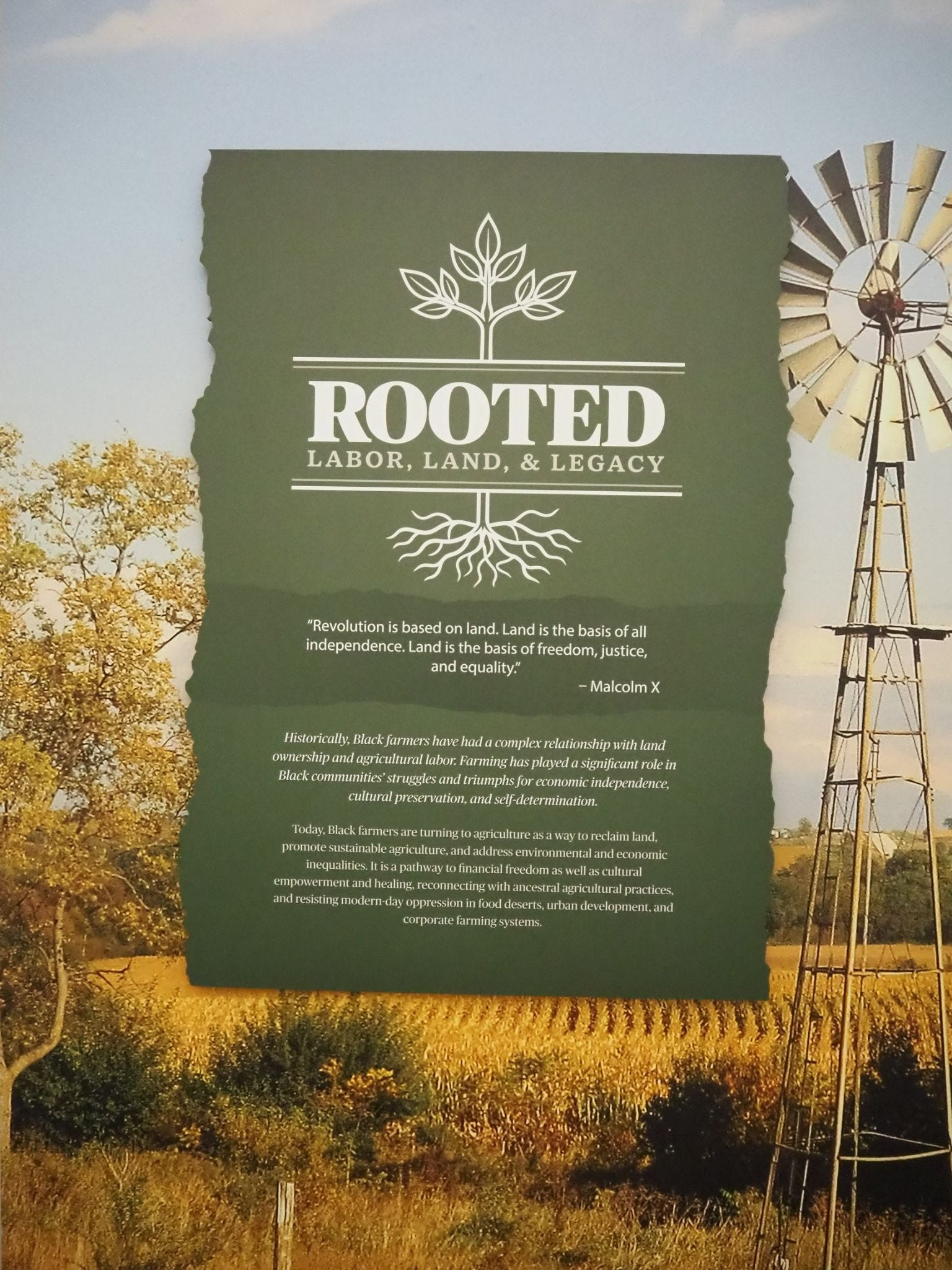
“This exhibit,” the museum explains, “celebrates the role farming plays in Black resiliency and activism. Farming has played a significant role in Black communities’ struggles and triumphs for economic independence, cultural preservation, and self-determination. Visitors will learn how Black farmers, nationwide and in Iowa, are turning to agriculture as a way to reclaim land, promote sustainability, and address environmental and economic inequalities.”
While many are celebrating the achievements of this nation over 250 years, this exhibit – put up last October and only up until August 15th – felt like a reckoning. For anyone interested in land, history, and movements for land and racial justice, this is obligatory learning.
The exhibit speaks to the “complex relationship” between Black folks and the land, a complexity that I as a white farmer had long been largely ignorant of. I remember first hearing Robert Pierce, a Black farmer based in the Madison, WI-area, speak several years ago as he told a crowd at Sinsinawa Mound that a key part of his work in engaging youth with the land was showing them that the hoe is a tool of liberation, not slavery. This felt like an awakening to a complexity on the land I was just attending to.
Between 1619–1865, this exhibit explains, nearly 7 million enslaved Africans generated 6.5-10 trillion dollars (in today’s dollars) for their enslavers. We all live in the shadows of that tragedy.
In an attempt to repair that massive harm, on January 16, 1865, near the end of the Civil War, General William Sherman issued Special Field Order no. 15, giving some 400,000 acres to 18,000 former slaves and their families, with plots divided into roughly forty acres per family. Later that year, the order was rescinded. It was a broken promise. We all live in the shadows of the failed promise of 40 acres and a mule.
This country desperately needs diversity on the land – different kinds of plants, creatures, microorganisms, as well as a diversity of people. We all suffer if there are only monocultures of people and other creatures of the earth.
Leaders of the movement
There have always been Black-led movements of farmers and advocates for a diversity on the land. This exhibit does the important work of introducing, or re-introducing, many of them. Dr. George Washington Carver (1860s-1943) of Tuskegee Institute in Alabama, for instance, was a pioneer in what is now called “regenerative agriculture.” Born into slavery, he’s known for his work with peanuts – a legume that is key to healing soil depleted from monocultures like cotton. Working at the Institute he taught countless farmers in the craft of organic farming.
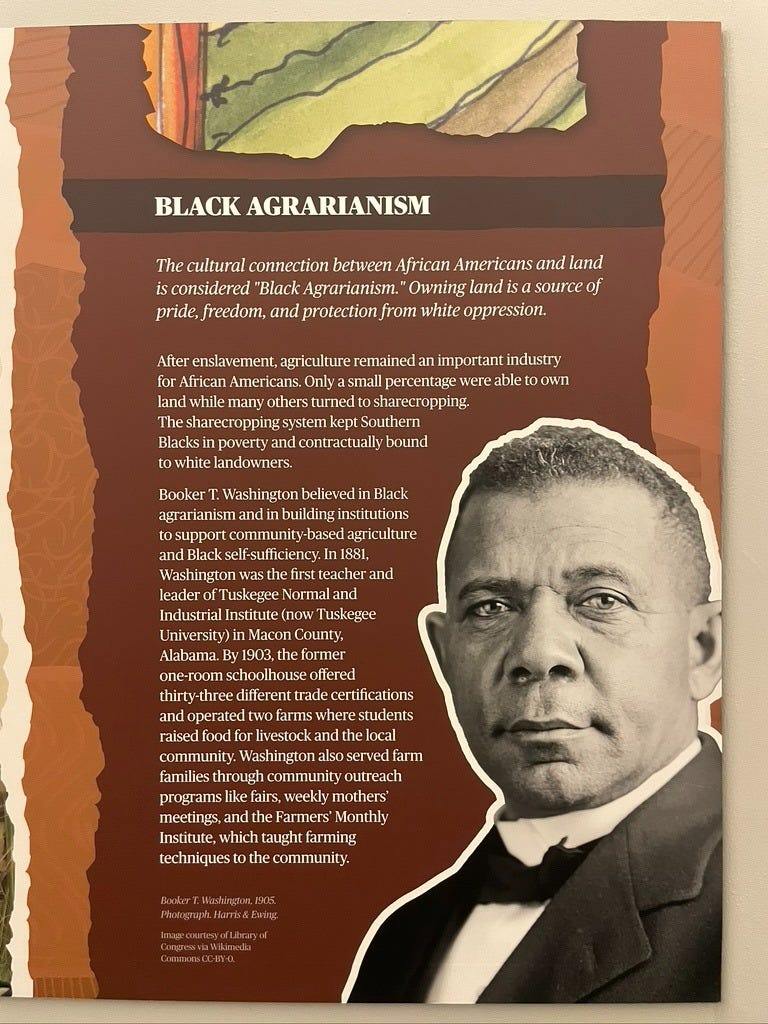
Dr. Booker T. Whatley (1915-2005), also from the Tuskegee Institute, is considered to be the inventor of the model that’s come to be known as Community Supported Agriculture (CSA), offering town folks an opportunity to eat local food and have a sense of connection with the land.
Fannie Lou Hamer (1917-1997) founded Freedom Farm Cooperative in 1969 in Sunflower County, Mississippi. Her farm was a base of organizing for the Civil Rights Movement. When civil rights activists questioned her about all the canning she was doing she replied, “If you have 400 cans of food, no one can push you around.”
But the exhibit doesn’t only feature historic figures of the past in different regions of the country. Minerva’s Meadows (State Center), Southern Goods (Waterloo), and Black Earth Gardens (Cedar Rapids) are three Black-led, Iowa-based farms featured in this important exhibit and who each advised this exhibit.
In 2024, Mari Hunt Wassink of Black Earth Gardens wrote:
“Instead of tasting the fruits of their labors and building a stable livelihood, my great-grandmother and her family were forced to flee the exploitative labor practices and racial terrorism in their community — there were at least 13 lynchings in their county prior to their exodus. For my ancestors, fleeing racism meant leaving farming behind for the slaughterhouses and urban centers of the Midwest. Since colonizers kidnapped my ancestors and brought them to the Americas in the 1700s, agriculture became the means by which their lives were stolen and their labor exploited.Today, I am reclaiming the wisdom and practices of my indigenous African ancestors to heal the land and my community through farming….I launched my farm, Black Earth Gardens, last year… a small-scale, regenerative farm that specializes in growing vegetables, fruits, and herbs that are culturally important to African Diaspora communities in Eastern Iowa, with an emphasis on dismantling food apartheid and expanding food sovereignty locally.”
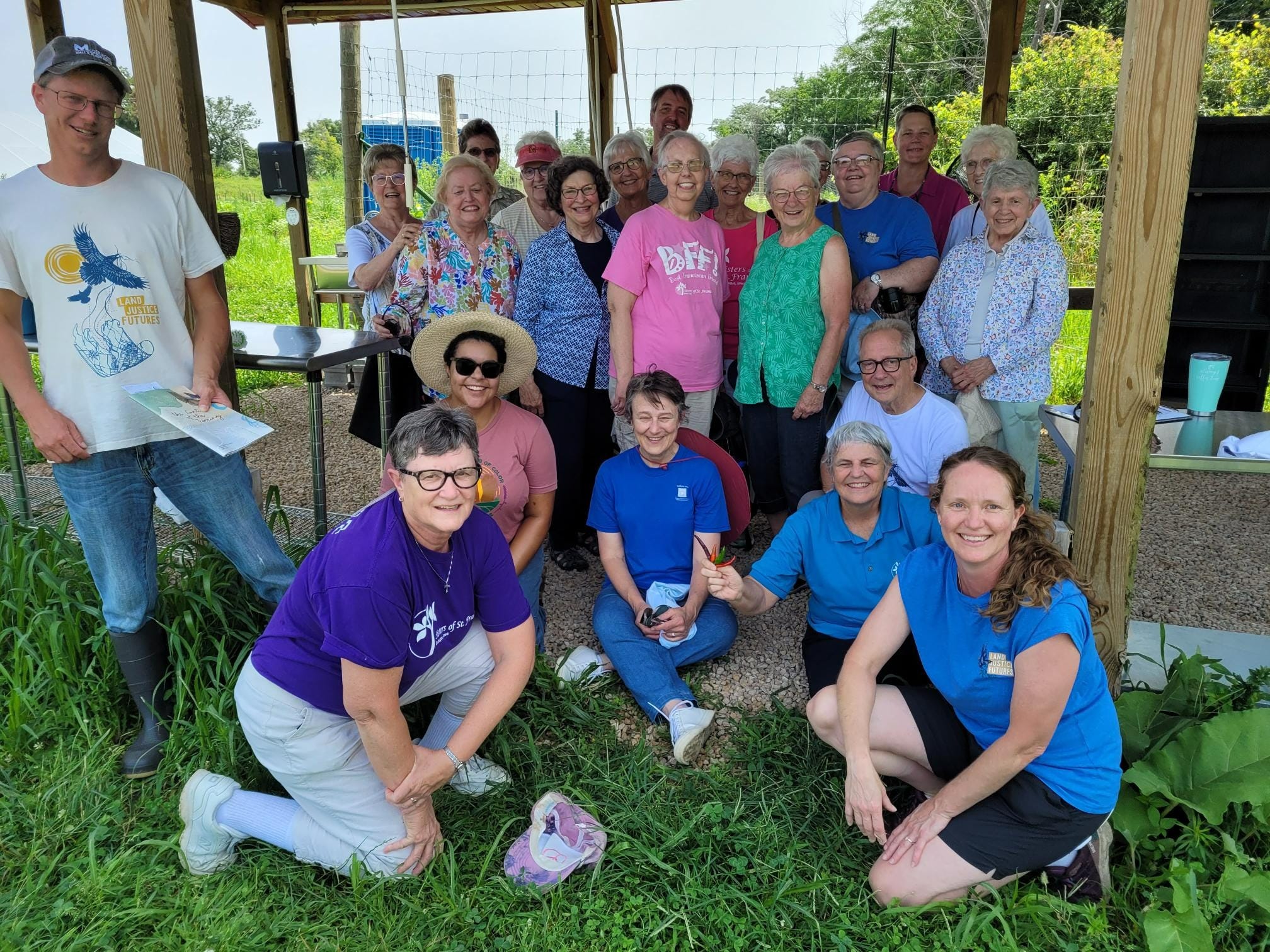
Mari Hunt Wassink of Black Earth Gardens near Cedar Rapids, IA with sisters and associates from Land Justice Futures,, 2025; photo: Sr. Marie Cigrand
Holding Space to Breathe
Another advisor to the Rooted exhibit is Todd Western III of Western Family Farms, the co-founder of Iowa Farmers of Color. His family’s farm is the oldest Black-owned farm in the state, stretching back to 1864. Western told me recently that according to the 2022 Iowa census there are 86,911 farms in the state. “How many Black farmers in Iowa does the census say there are?” I ask. “75,” he replies. “And I have only been able to find five.”
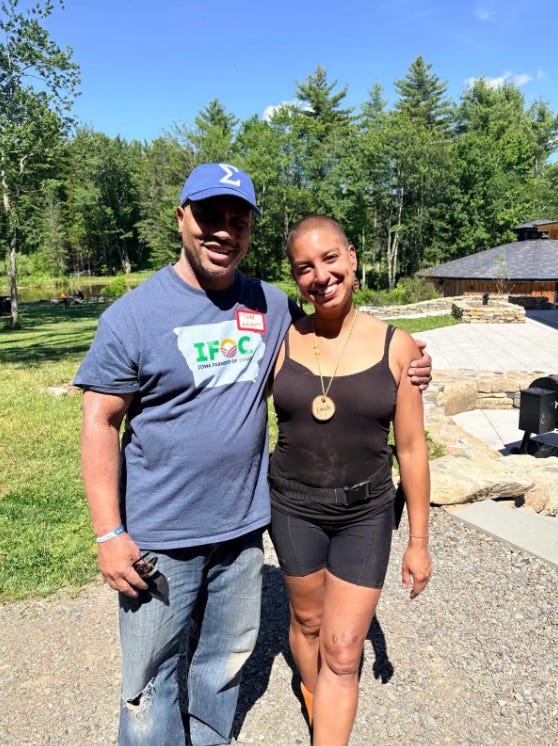
Todd Western with Leah Penniman, author of Farming While Black, and co-founder of Soul Fire Farm in update New York
I also recently spoke with Todd’s son, Todd Western IV, who helps on the Iowa family farm but also runs his own Freedom Farms in Minneapolis (he grows for Sean Sherman’s newly reopened Indigena by Owamni). We were talking about the significance of Black-led farms and land projects in Iowa and beyond. The phrase that he used was “the importance of holding space.” Holding space: that phrase is lingering within me, for I can imagine that holding space helps certain people of color in this country to breathe.
Which brings to mind a poem by Ross Gay about Eric Garner, who told his arresting officer in NYC who had put him in a chokehold, “I can’t breathe” eleven times before losing consciousness and ultimately his life. I was moved when I first read this poem in Leah Penniman’s important book, Farming While Black. I remain moved:
A Small Needful Fact
Is that Eric Garner worked
for some time for the Parks and Rec.
Horticultural Department, which means,
perhaps, that with his very large hands,
perhaps, in all likelihood,
he put gently into the earth
some plants which, most likely,
some of them, in all likelihood,
continue to grow, continue
to do what such plants do, like house
and feed small and necessary creatures,
like being pleasant to touch and smell,
like converting sunlight
into food, like making it easier
for us to breathe.
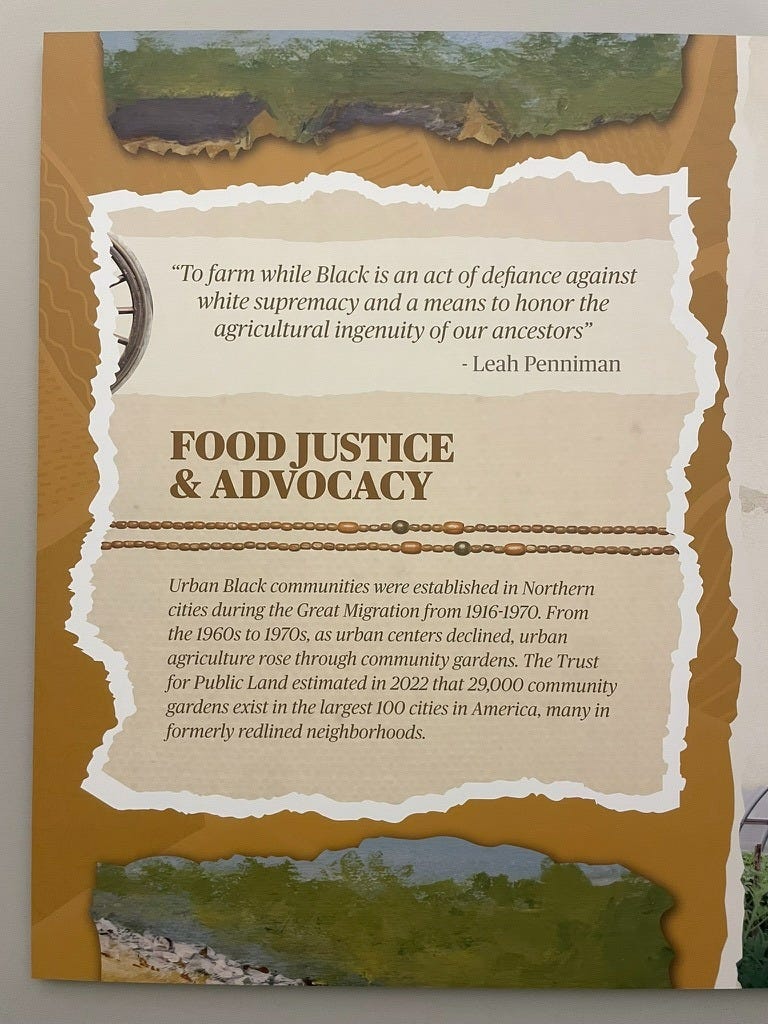
The exhibit is open to the public through August 15th, 2026
Exhibit photos taken by Olivia Loucks
Save the Date: Iowa Farmers of Color gathering - Dubuque, Iowa - March 12-13, 2027
Link to my previous essay, “Black Land Matters: Land Justice in Detroit”